
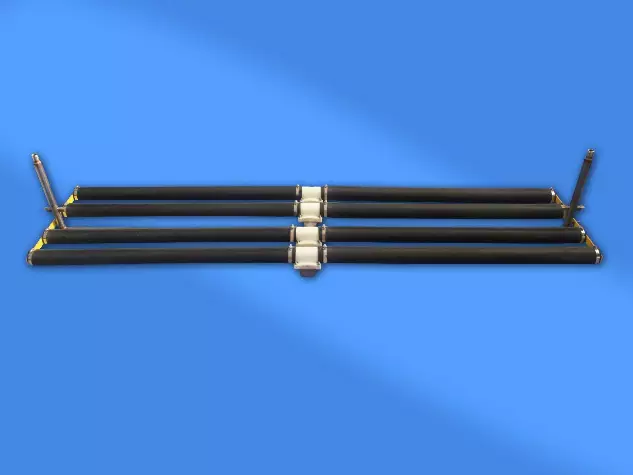
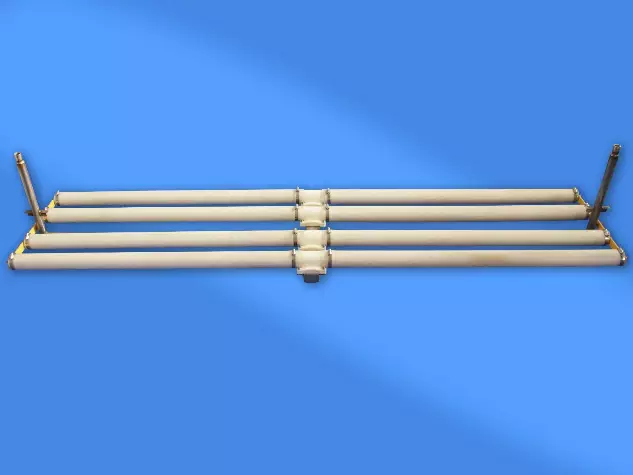
Eight-Tube Suspended Chain Aerator
The eight-tube suspended chain aerator consists of an inner liner, diaphragm, clamp, air chamber, and counterweight clamp; the aeration diaphragm is made of silicone rubber or EPDM, and the inner liner is available in UPVC or ABS; the clamp is made of 304 stainless steel, and the air chamber is made of 304 stainless steel.
Product Descriptions
Specifications and Models
XG-1300-8
Product Advantages and Features
Ø Composite diaphragm with a long lifespan, reaching 5-8 years, overcoming the shortcomings of rubber diaphragms such as easy tearing and short lifespan.
Ø Strong impact resistance and not easily damaged.
Ø Internal check valve eliminates backflow.
Ø Float tube is integrally welded using UV-resistant materials, eliminating air leakage and extending service life.
Ø All materials are corrosion-resistant.
Product Technical Parameters
| Project | Unit | Parameter |
| Effective service area (2 tubes) | m2/set | 5-10 |
| Effective service area (3 tubes) | m2/set | 7-15 |
| Effective service area (4 tubes) | m2/set | 10-20 |
| Effective service area (8 tubes) | m2/set | 20-40 |
| Membrane thickness | mm | 1.7-2 |
| Airflow (2 tubes) | m3/set | 10-20 |
| Airflow (3 tubes) | m3/set | 15-30 |
| Airflow (4 tubes) | m3/set | 20-40 |
| Airflow (8 tubes) | m3/set | 40-80 |
| Tear resistance (right angle) | KN/m | 60-68 |
| Drag loss | Pa | 3000-8000 |
| Pore length | mm | 0.8-2 |
| Membrane diameter | mm | 65-69 |
| Oxygen dissolution effect | ppm(Clear water) | >6 |
| Pressure resistance | kg/cm2 | >3 |
| Theoretical power efficiency | kgo2/kw·h | 6.5 |
| Oxygenation capacity | kg/h·strip | >0.89 |
| Oxygen utilization rate | % | >30 |
| Number of micropores (2 tubes) | each | 20000 |
| Number of micropores (3 tubes) | each | 30000 |
| Number of micropores (4 tubes) | each | 40000 |
| Number of micropores (8 tubes) | each | 80000 |
Installation Procedure
5.1 Suspended chain aerators are generally evenly distributed at the bottom of the water treatment tank, 100-250mm from the bottom, with a longitudinal spacing of 300-1000mm.
5.2 Installation Components and Accessories
Ø Air supply hose and clamps
Ø Air supply float pipe and plugs
Ø Suspended chain connectors and clamps
Ø Suspended chain air supply pipe and clamps
Ø Aerators
5.3 Installation Method
Ø Arrange the air supply float pipes and plugs in sequence on the bottom of the tank. Weld them into a single pipe using a plastic welding machine. Ensure the suspended chain connectors are on a parallel line.
Ø Cut the suspended chain to the design dimensions. Connect one end of the chain to the aerator and the other end to the float pipe using clamps.
Ø Connect the air supply hose to the float pipe and tighten it with clamps.
Ø Connect the steel wire rope to the float pipe.
Ø Tighten the air supply hose opening to ensure no air leakage.
Ø Tie the steel wire rope to the pre-embedded parts at the edge of the pool using a soft rope. Begin filling with water.
Ø Once the pool is full, first turn on the blower to clean the pipeline. Connect the air supply hose to the air distribution pipe. Adjust the length of the steel wire rope.
Ø Start the blower and adjust the air inlet valve to ensure even aeration of each chain.
Ø Carefully check all connections for leaks.
5.4 Installation Precautions
Ø The clamps must be securely inserted into the joint grooves.
Ø The air pipeline must be purged before hose installation.
Ø During and after installation, open flame operations such as explosive connections are strictly prohibited on site. If such operations are necessary, cover the aerators with fire-resistant material to prevent damage to the equipment.
Ø When handling and installing the aerators, do not throw or drag them to avoid abrasion of the pipe walls.
Ø After installation, check that all connections meet the requirements.
Common Faults and Solutions of Suspended Chain Aerators
| Serial Number | Fault Phenomenon | Fault Cause | Solution |
| 1 | The aeration rate varies for each chain | The air supply rate varies for each chain | Adjust the air inlet valve |
| 2 | Uneven aeration in certain areas | Aerator blockage | 1. Clean with acid washing equipment; 2. Turn off or reduce the air supply to other chains, and increase the air supply to this chain until aeration is uniform. 3. Remove the aerator and clean it. |
| 3 | Air leakage at pipe joint | Loose clamp | Tighten the clamp or replace it |
| 4 | Large air bubbles are present in parts of the aeration tank | The membrane is torn | The aeration membrane needs to be replaced |